Chapter 3
Part 1
She laid the chart flat and hit the curve with her knuckle.
“Help me prove it’s salvageable. Your Bureau data against my mother’s evacuation math.”
The lantern guttered between them. Vess’s shadow fell across her numbers — the eastern escarpment stations, the southern profiles in her father’s octopus-gall ink, the self-steepening acceleration line she’d plotted three times because twice wasn’t enough to believe. The composite told one story. Lyra’s relocation arithmetic told another. Both couldn’t be true.
He didn’t sit. He stood on the far side of the chart table with his hands at his sides, reading the curve the way she’d seen him read coastline — silently, holding figures in memory before committing.
“What are you offering in return?”
“Everything I have. Every station, every measurement, my father’s full archive.”
His gaze moved to the case beside her — salt-stained leather, the clasp worn to a dull shine by eleven years of hands that weren’t hers. She watched him register its age. Its weight.
“How long did he survey this coastline?”
“Eleven years.”
“I need the night to decide.”
“You don’t have the night.” She kept her voice level. “Corren’s deadline is end of week. Preliminary viability determination only. No further study.”
Something shifted behind his face — not surprise, not denial. Recalculation. She’d quoted the directive nearly verbatim. She shouldn’t have known the language. She shouldn’t have known the name.
He didn’t ask how.
Wind caught the shelter canvas and cracked it taut against its frame. Neither of them moved. The lantern flame bent sideways, throwing the acceleration curve into sharp relief — the inflection point where she’d pressed too hard, where the line stopped being arithmetic and became a countdown.
She wasn’t leveraging him. She’d burned that option the moment she said help me instead of trade with me. What she’d put on the table was trust — her father’s life’s work, unguarded, pages open — and now she stood in the silence where Vess decided what that was worth.
The canvas snapped again. He looked at the archive case, then at her, and his hand hadn’t moved.
Part 2
Corren’s directive lay flat on the pine table like a blade someone had left unsheathed.
Viability determination only. Do not recommend further study. The last sentence underlined twice — the same hand, the same ink, the same cadence he’d read on Pellos, Vathe, Sidden, Korrach. Four islands. Four times he’d checked N. The math had justified it each time, or close enough — close enough that the discomfort in his chest could be filed under professional caution rather than conscience. Clean margins. Defensible numbers. Nothing in the readings he couldn’t talk himself past once the form was signed and the packet vessel took it away from him.
He set the directive beside Kae’s composite chart.
Her handwriting filled the margins. Sharp, sure, pressed hard at the inflection points where the curve steepened past anything the Bureau’s models could accommodate. Her father’s octopus-gall stations ran beneath her own in darker ink, and where the two lines diverged the gap was not ambiguity but acceleration. The curve didn’t argue. It screamed.
He thought about her eyes in the lantern light. Help me. Not pleading. Demanding. The way they’d held him without flinching, as if she’d already decided he was worth the risk of being wrong about. Her proximity had gotten inside his calculations. He couldn’t separate what the data was telling him from what she was — couldn’t tell whether the numbers justified defiance or whether wanting her to be right had bent his judgment past recovery.
The checkbox waited.
He picked up the Bureau pen. Set its nib against the form. His hand was steady — it was always steady; that was the thing about him that should have been a warning — and he marked N.
Not recommended for further study.
The ink dried. He blotted it. He folded the carbon into the transit case for the next packet vessel. Standard procedure. Clean file.
Then he sat in the dark harbor room with Kae’s composite still open on the table beside the closed case, and did not move to put her chart away.
Part 3
Three elders stood when Lyra entered and did not sit again.
She placed her revised projections on the basalt table — Kae’s station numbers inked in red beside her own actuarial columns, the eastern terrace figures circled twice. The chamber windows were latched. No clerk. Torath’s bench groaned as he shifted his weight away from the pages as though proximity were contamination.
“Eighteen months,” Lyra said. “Not three seasons. Eighteen months before the eastern terrace cannot hold a structure.”
Sera’s eyes moved from the projections to Lyra’s face. “Your daughter’s measurements.”
“My daughter’s measurements.”
“Does she know you’re using them to argue for departure?”
Lyra kept her hands flat on the table — the same posture she’d held when the relocation document first surfaced, the same stone under her palms. “My daughter’s numbers argue for themselves.”
Pellar stared at the table’s surface. The three standing elders remained standing — Torath’s cousin among them, arms crossed, jaw set in the particular Maran configuration that meant a word had already been broken and the room was deciding whose. The relocation terms had circulated through the harbor in two days. Lyra had heard her own name spoken at the fish-drying racks with a tone usually reserved for storms.
Torath picked up the projection sheet. He read the eighteen-month figure. He read the eastern terrace yield estimate beneath it — four families’ food for one season, where last year it fed eleven. He set the page down with the care of a man handling something that might cut him.
“If we refuse Hursh’s terms,” he said, and his voice had flattened to the recitation register he’d used when he read the blank cultural preservation line, “what is our alternative?”
Lyra opened her mouth. Every answer she had rehearsed in the dark hours before dawn contained the same word. Port allocation. Skilled-labor placement. Provisional housing. Western settlement corridor. Every road she could name ran through Hurshi territory. Every option required asking.
The silence pooled around the basalt table like water finding its level, and no one in the chamber could name a single path forward that did not taste of someone else’s charity.
Part 4
Kae laid her father’s charts across the rock table.
She’d carried the salt-stained case up from the harbor shelter in darkness, spreading eleven years of his hand — octopus-gall ink, station profiles, the private symbols she still couldn’t read — across stone still cold from the night. Then she waited.
Vess came without his transit case. He carried a secondary leather satchel she’d never seen him open, and he set it on the table’s edge with both hands, the way a man sets down something that can’t be taken back. Inside: Bureau regression models stamped INTERNAL. Substrate anomaly reports with distribution lists of one. Station decommission records for sites she’d surveyed six days ago as though they were active.
“No one sees these.” His voice was stripped of the diplomatic register. “No one knows I showed you. Say it.”
“No one knows.”
He unfolded the regression models. She unrolled her father’s southern profiles. They worked without speaking — her hands moving station to station, his holding pages flat against the predawn wind that crept through the shelter’s open wall.
The alignment announced itself at Station Three. Her father’s substrate readings filled a gap in the Bureau’s seasonal record — a missing autumn, no explanation logged. Station Four: another gap, another precise fill. Station Six: the same. Everywhere the Bureau showed absence, her father had measured presence. Not approximations. Exact parameters, exact locations, as if he’d known which seasons would vanish from the official record before they vanished.
“He wasn’t duplicating your data.” She kept her voice level. “He was replacing it.”
Vess didn’t respond.
She looked up. His face was doing the thing it did — controlled, every muscle rearranging behind the mask of professional stillness, the suppression she’d learned to read across five evenings and now recognized as confirmation.
She pulled the decommission record for Station Four. Stamped and dated. Bureau-abandoned, Year 982.
Her father’s first measurement at that station: Year 983. One year after the Bureau walked away.
Neither of them said the number out loud.
Part 5
The carbon form sat where he’d left it hours ago, the N still visible through the back of the page.
Vess pulled it toward him. The ink had dried into the fiber — his fifth consecutive non-viable, his fifth island sentenced in Bureau shorthand. He ran his thumb across the checkbox. Pellos. Vathe. Sidden. Korrach. Each name a copper taste he’d learned to swallow. The N on Mara’s form was the same gesture, the same muscle memory, the same man.
Except the man who checked it had not yet seen a dead surveyor’s charts fill Bureau gaps like bone finding socket.
He uncapped his pen. Pulled a fresh sheet — unheaded, unlogged, the same blank stock he’d used for his private column. But this time he fed it over the carbon, pressing the Bureau’s own backing sheet beneath his words so the copy would register in the transit case’s official file. Procedural. Traceable. Real.
He wrote in Bureau language. Clipped clauses, passive construction, the gray syntax designed to make readers’ eyes slide past without catching. Anomalous substrate signatures identified at Stations Three, Four, and Six warrant extended assessment period to ensure viability determination meets Bureau evidentiary standards. No recommendation for further study — Corren’s directive forbade those words. But the sentence required it without saying it. A Y dressed in N’s clothing.
He signed his name beneath the text. Set the pen down. Looked at his signature beside the checked N on the original form — two documents, two answers, his career visible in the contradiction between them.
He folded the interim report into a Bureau envelope, sealed it with the wax stamp from his transit case. Walked to the harbor. The harbormaster took it without looking up, dropped it into the morning packet satchel between tariff notices.
Walking back, the street moved.
Not the lurch of a stumble — a slow roll that started in his heels and climbed his spine, vertebra by vertebra, until his teeth hummed with it. He stopped. Listened. The night was still. A woman carried a lamp past him without breaking stride. A cat sat on a wall, undisturbed.
Nine seconds. Then silence so complete it had weight.
Part 6
The lantern guttered and she fed it more wick.
Her father’s oldest chart book lay open on the rock table, spine cracked, pages stiff with salt and age. She’d been through it four times since giving Vess the archive — the southern profiles, the descending annotations, the concentric-circle symbol she still couldn’t read. Four times, and four times the same stations, the same numbers draining downward: forty-one, thirty-six, twenty-nine. A quantity leaving the ground beneath him.
She turned past Station Six. The binding resisted. She pressed the spine flat and felt paper where paper shouldn’t be — a sheet folded into the stitching, thin enough to disappear against the endboard. She worked it free with her thumbnail.
A list. Dates in his hand, paired with locations. The first three she knew: Mara’s southern headlands, the eastern escarpment, the northwestern point. Below those, names she’d never seen. Tessavar. Ommed. Kal Sothis. Pellar’s Rock. Islands — they had to be islands — but none appeared on any chart she’d studied, none spoken in the harbor, none carried home on traders’ tongues.
Beside each location, the symbol. Two concentric circles bisected by a vertical line. Beside each symbol, a number.
The numbers descended.
Not across stations. Across islands. Forty-one on Mara. Thirty-three on Tessavar. Twenty-six on Ommed. Nineteen on Kal Sothis. The same drainage, the same direction — but the scale was wrong. He hadn’t been tracking Mara’s illness. He’d been tracking something that moved beneath all of them.
Her hands held the page flat. Steady. Her breath came shallow and uneven against the lantern’s heat.
At the bottom, in ink darker than the rest — newer, the nib pressed hard — a single line: coordinates and a bearing. North-northeast.
She didn’t know what was there. No chart she owned would tell her.
She folded the page back into the spine. Closed the book. Set both palms on the cover the way Dak pressed his hands to wet stone.
Outside, the ground hummed — longer than before, low enough to settle in her teeth and stay.
Part 7
She held the page out like a blade.
Vess took it. The lantern threw his shadow across the shelter’s low ceiling as he read — once fast, once slow. His thumb settled on the second name. Ommed. It stayed there.
“He was measuring this on other islands,” Kae said. “Not just Mara.”
Vess didn’t look up. His thumb pressed harder, whitening at the nail.
“I’ve assessed three of these islands.”
She stepped back. Half a step — her heel found the shelter wall and stopped. The space between them, which had held charts and shared silence and something she’d been building toward for days, contracted into a distance she could measure in heartbeats. Three islands. Her father’s hand on each one, recording numbers the Bureau erased. And the Bureau sent Vess to all three, and then to Mara, and he’d sat across from her for five evenings without saying the names.
His eyes came up. Steady. Open. Offering her something that could be honesty or could be the practiced calm of a man who’d learned to hold still when the ground moved.
She wanted it to be simple.
“What did your assessments find?”
“What the Bureau expected me to find.”
She reached for the page. Her fingers closed on the edge opposite his thumb, and she pulled it free without touching his skin — a precision that cost her more than the question had. The paper was warm where he’d held it.
She could be sitting across from the man who would help her save six hundred lives. She could be sitting across from the instrument that buried four islands and was sharpening itself for the fifth. Both versions wore his face. Both had filed that interim report.
She picked up the southern headlands chart. Spread it flat. Studied a station she’d already memorized, because studying it meant not asking the thing her throat was building toward — did you know about his work when you came here — and the question filled the shelter the way smoke fills a room with no windows, thickening the air between every breath until breathing itself became the act of choosing not to speak.
Part 8
Lyra was waiting outside the council chamber.
No greeting. No preamble. She stood with her back against the corridor’s stone wall, arms crossed, and spoke before Kae’s boot finished its step.
“The assessor’s interim report recommends extended study. Corren’s office will reject it. You have days, not weeks.”
Kae stopped. The charts under her arm shifted; she caught them against her ribs, feeling the hidden page crinkle beneath the stack — her father’s list, his island names, his descending numbers pressing into her skin through leather and linen.
“How do you know about the report.”
Not a question. A demand. Lyra’s eyes didn’t move from hers.
“I know because I’ve been reading Bureau correspondence for three months and their process has one speed: the speed they choose.” Each word landed flat, deliberate, stripped of the cost-accounting tone she’d used in council. This was something rawer. “Their carbon routes through a single checkpoint. The packet vessel carries the reply. When it docks, the timeline collapses.”
Kae shifted the charts higher. “What do you want.”
Lyra’s mouth opened. Closed. Her hands, still crossed at her chest, tightened — fingers pressing into her own sleeves hard enough to whiten the knuckles. The corridor was empty. Somewhere below them, through stone and packed earth, the ground held its breath or Kae imagined it did.
“I want you to be right.” Lyra’s voice dropped below its usual register. “I need you to be fast.”
The crack lasted two seconds. Maybe three. Then her shoulders squared, her jaw reset, and she pushed off the wall and walked back through the chamber door without turning. The latch caught. The wood settled into its frame with the sound of something finished.
Kae stood in the corridor holding her charts, her father’s hidden page folded against her ribs, watching the door shut on the woman who had commissioned her survey as a negotiating tool — and just asked her to win with it.
Part 9
Kae didn’t bring her instruments.
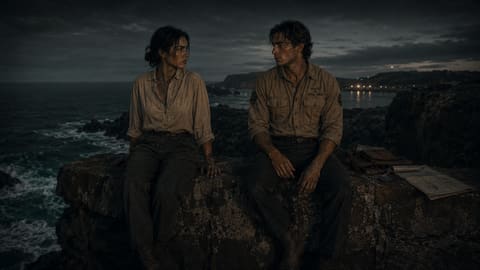
Vess didn’t ask why. They sat on the rock shelf at the northwestern station with their legs over the edge, the ocean black below, stars cold on the headland. The wind had dropped. She could hear him breathe — slow, measured, the rhythm of a man counting something he wouldn’t name. She breathed at a different pace, and both of them knew it.
His hand rested on the basalt between them. She watched it. The knuckles were scraped from where he’d braced against the cliff path coming up. He watched the water.
She leaned — not toward him, toward the edge, reaching to brush loose stone from the cliff face. Her shoulder pressed his arm. The contact lasted two seconds, maybe three. He turned. She was already pulling back, eyes on the rock dust coating her fingers, rubbing it between thumb and forefinger the way Dak had kept his palm flat on the sea-wet boulder — with her whole weight in the touch, listening through skin.
“The substrate’s loosening here too.”
The sentence was nothing. A deflection she could have made with her back turned.
He heard the breath she took before she leaned. She heard his stop. Neither corrected the record.
Six inches of cold stone between his hand and her knee. She pressed her palm flat against it and felt the basalt’s faint grain, the mineral chill, the absence of the tremor that had been settling in her teeth for days. The ground was quiet. The ground was never quiet.
She lifted her hand. His fingers had shifted — a centimeter closer, maybe less — and stopped.
Around the southern headland, a lantern swung into view. Small, steady, carried on a mast she recognized before the hull resolved: the packet vessel, running early, already making for harbor.
Part 10
The heat on his arm wouldn’t fade.
Vess shut the harbor room door and stood in the dark, pressing his sleeve where her shoulder had been. The lean — toward him, past him, away. Rock dust on her fingers. A surveyor’s excuse delivered in a voice that forgot to be steady. He didn’t know what it was. He needed to not know.
He lit the lamp. Unpacked the Bureau transit case. The sealed secondary compartment opened with the combination he’d set in Hursh fourteen months ago, before Mara was a name on his schedule. Inside: the classified index. Every assessed island cross-referenced by geological profile, substrate composition, viability determination. Clean columns. Institutional certainty.
He found Tessavar first. Viability negative. Remediation not recommended. Population relocated, Year 989. Geological profile: substrate anomalies consistent with deep destabilization. Assessment signature: Vess Hurren.
Ommed. Viability negative. Remediation not applicable. Population pending relocation. Substrate anomalies consistent with deep destabilization. His thumb found the entry and pressed until the nail whitened — the same reflex, the same name, the same cost.
Kal Sothis. Viability negative. Natural geological process. His signature again.
He closed the index. Opened it. Ran his finger down the destabilization column — island after island, the same notation repeated like a clerk’s stamp: natural geological process, remediation not applicable. The phrase had a rhythm. He’d written it himself on three separate assessments without hearing it.
He heard it now.
The dead man’s descending numbers — forty-one, thirty-three, twenty-six, nineteen — tracking something draining beneath islands Vess had walked, measured, and signed away. The decommissioned stations where the Bureau stopped looking. The gaps the dead man filled with ink mixed from octopus gall, as if he’d known which records would vanish.
Six inches of cold stone on a cliff edge. Her breath before the lean.
Through the window, the packet vessel’s lantern swung at anchor. Whatever Corren’s seal contained would arrive with morning light, and the man who opened it would be either an assessor following protocol or something without a Bureau word for what he’d become.
Vess locked the compartment. He did not sleep.